
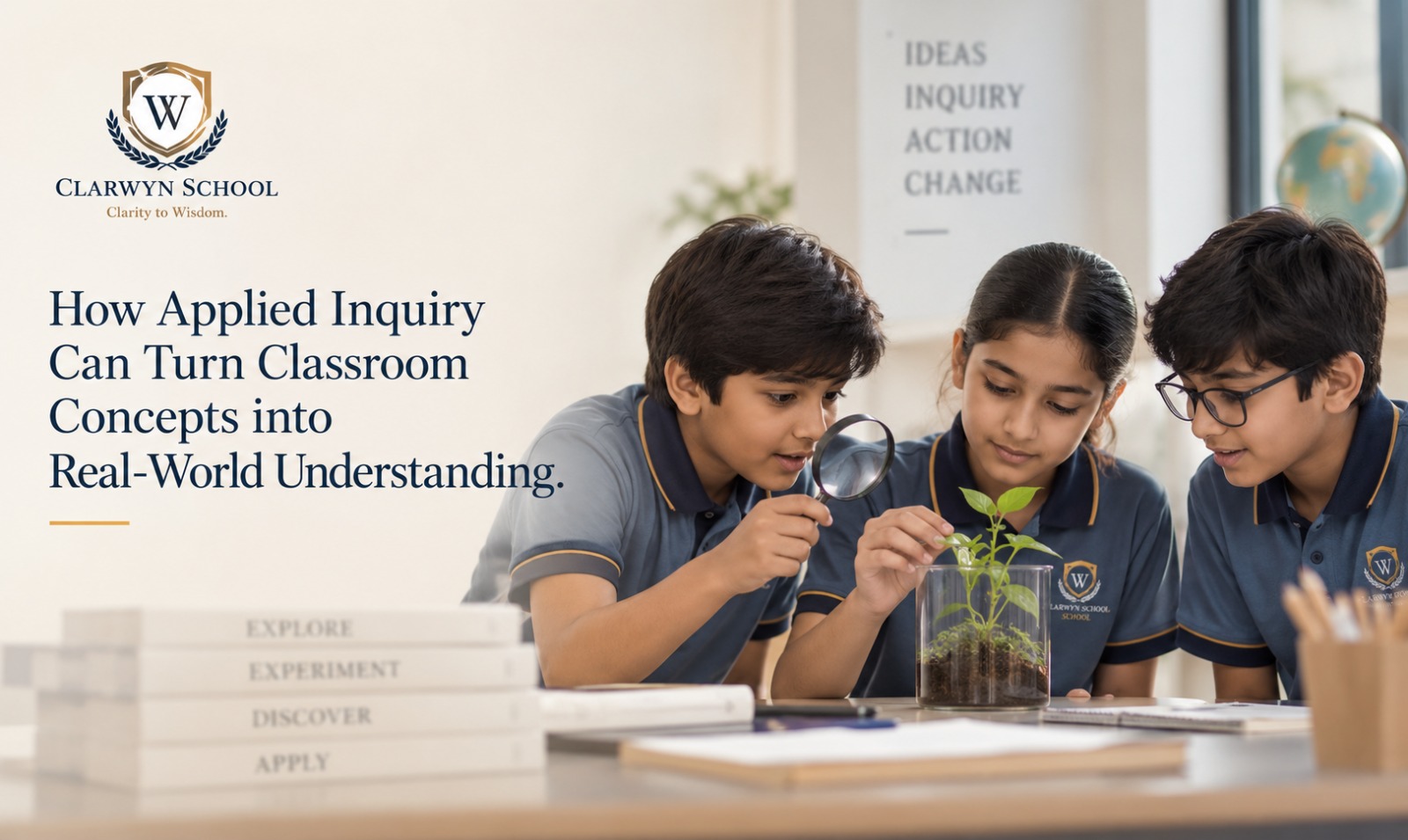
Key Highlights
- Connecting classroom concepts with practical experiences
- Understanding the role of questioning, research and application
- The Clarwyn Praxis: Understand, Question, Practise, Apply and Reflect
- Moving from textbook learning to projects, models and presentations
- Developing curiosity, craftsmanship, mastery and stewardship
- Creating visible evidence of student learning
Introduction
A classroom concept becomes more meaningful when students can understand where it exists beyond the textbook. For parents exploring Top Schools in Noida, this approach can offer a useful perspective on how academic learning connects with real-world experiences. Learning about environmental science, for instance, can become more engaging when students investigate a local issue, collect information and suggest solutions.
At Clarwyn International School, Noida, the academic direction of the school is built around CBSE with Applied Inquiry, where clear teaching is combined with questioning and hands-on application. Its stated learning rhythm, The Clarwyn Praxis, takes students through five stages: Understand, Question, Practise, Apply and Reflect.
What Is Applied Inquiry in Education?
Applied inquiry combines curiosity with action. Students do not simply receive information; they are encouraged to investigate how knowledge works and where it can be used.
For example, a science lesson on water conservation could progress from understanding the water cycle to examining consumption patterns, researching conservation methods and creating a model or presentation. A social science lesson could involve researching a community issue and presenting evidence-based observations.
This creates an important connection:
Concept → Question → Research → Application → Reflection
Such a sequence can encourage students to see knowledge as something they can use rather than something they only need to remember.
From Understanding to Application
The first stage of meaningful learning is clarity. Students need to understand the learning goal, key concept and expected outcome before they can apply their knowledge effectively.
The next step is questioning. Purposeful questions can encourage learners to examine assumptions, search for evidence and explore alternative explanations. After this, guided practice helps students strengthen their understanding before they attempt independent application.
The approach followed here explicitly places Understand, Question, Practise, Apply and Reflect into the learning process. Students can therefore move from acquiring information to using it through laboratories, libraries, studios, projects and presentations.
How The Clarwyn Praxis Makes Learning Active
The Clarwyn Praxis is presented as more than a classroom slogan. It provides a structured teaching-learning rhythm in which teachers make goals visible, model expected work, guide practice and check understanding before students apply their learning.
This balance is important. Inquiry does not mean leaving students without direction. Instead, teacher guidance and student participation work together.
A student may first understand a concept through explicit teaching, then investigate it through questions, practise the associated skill and finally create something that demonstrates understanding. Reflection then gives the learner an opportunity to identify mistakes, respond to feedback and improve the final work.
Learning Through Labs, Projects and Real-World Outputs
One of the strongest ways to make applied learning visible is through tangible work. The campus learning model includes an Atheneum Library, science and subject laboratories, AI and robotics, engineering, technology, STEM, coding, venture and multimedia spaces. These environments are designed around different forms of student output.
Instead of stopping at theoretical understanding, students can progress towards:
The school’s learning-evidence framework describes this progression through activities such as Design → Code → Build → Test → Explain. This gives students opportunities to demonstrate what they know through working models, data dashboards, design pitches and explanatory presentations.
Building Skills Beyond Textbooks
Real-world understanding requires more than subject knowledge. Students also need communication, collaboration, discipline and the ability to improve their work.
The Wisdom Compass provides eight habits—Clarity, Curiosity, Courage, Courtesy, Integrity, Craftsmanship, Mastery and Stewardship—that connect academic learning with everyday conduct. For example, curiosity encourages research and questioning, while craftsmanship focuses on revision, detail and producing work worth sharing. Mastery emphasises practice, feedback and continuous improvement.
Conclusion
Applied inquiry can transform classroom learning by giving students opportunities to question, investigate, create, test, explain and reflect. When academic concepts are connected with practical tasks, learners can begin to understand not only what they are learning but also why it matters and how it can be used.
At Clarwyn International School, Noida, for families exploring Top Schools in Noida, an academic model that combines structured CBSE learning with purposeful inquiry offers an interesting perspective on modern education. The emphasis on visible learning, practical application, dedicated learning spaces and values-based development shows how classroom concepts can gradually become meaningful real-world understanding.
FAQs Question
Q. 1 How does applied inquiry improve student learning?
Ans : It encourages students to connect concepts with questions, research, practical tasks and reflection.
Q. 2 What is The Clarwyn Praxis?
Ans : It is a five-stage learning rhythm based on Understand, Question, Practise, Apply and Reflect.
Q. 3 Does applied inquiry replace traditional classroom teaching?
Ans : No. The approach combines clear teaching and guided practice with questioning and hands-on application.
Q. 4 How can students demonstrate applied learning?
Ans : They may create models, prototypes, presentations, data stories, projects, performances or other visible outputs.
Q. 5 Why are laboratories and studios important for inquiry-based learning?
Ans : They provide spaces where students can experiment, build, test, research and communicate their understanding.
Q. 6 What values support applied learning?
Ans : The Wisdom Compass highlights Clarity, Curiosity, Courage, Courtesy, Integrity, Craftsmanship, Mastery and Stewardship.