
Raising Confident Communicators: Why Listening Comes Before Speaking
Children become confident communicators when adults create room for them to think, listen, ask, explain and try again.
Communication confidence is often mistaken for speaking loudly, answering quickly or performing without hesitation. Real confidence is broader. It includes listening carefully, organising a thought, choosing words, reading the audience, asking for clarification and being willing to improve an explanation.
Children develop these habits when adults value the process of communication, not only the final performance.
Listening is the first communication skill
A child who listens well can respond to the idea rather than simply waiting for a turn. Listening also develops vocabulary, empathy, attention and the ability to notice tone and detail.
At home, adults can model this by putting aside distractions, allowing the child to finish and reflecting back the main idea before offering advice.
Thinking time protects better answers
Some children answer immediately; others need a pause. Speed is not the same as depth. When adults rush to fill silence or redirect the question, children may learn that only fast responses are valued.
A few quiet seconds, a chance to sketch or a brief conversation with a partner can help more learners form a meaningful response.
“A confident communicator is not always the loudest voice. It is the person who can listen, think and make meaning clear.”
Questions build both clarity and courage
Children need practice in asking for explanation, checking meaning and challenging an idea respectfully. A classroom in which only the teacher asks questions limits communication to answering.
At home, replace repeated testing questions with invitations such as: What makes you think that? What did you notice? Which part is still unclear?
Reading and vocabulary make expression more precise
Confidence grows when children have words for what they want to say. Stories, information texts, conversation, music, travel, art and everyday experiences all expand the language available to them.
Instead of correcting every sentence mid-flow, adults can first respond to the meaning, then model a clearer word or structure naturally.
|
Try these prompts instead of ‘Speak up’ 1. Take a moment – what is the main idea you want us to understand? 2. Can you give one example? 3. Which word would make that more precise? 4. What did you hear the other person say? 5. Would you like to try that explanation once more? |
Feedback should lead to another attempt
A presentation, paragraph, debate or performance should not be treated as a one-time judgement. Children become more secure when feedback is specific and followed by a real opportunity to revise.
Useful feedback might focus on one next step: organise the sequence, give evidence, slow the pace, project the voice, listen to the question or make the conclusion clearer.
Authentic audiences give communication a purpose
Children communicate differently when someone genuinely needs to understand. Explaining an experiment, presenting a design, introducing a performance, interviewing a community member or guiding a younger learner creates a reason to be clear and considerate.
Public confidence should grow gradually, with rehearsal and choice, rather than through forced exposure.
Repeated, low-stakes opportunities build durable confidence
Confidence is easier to build when communication is part of ordinary life rather than reserved for a major stage. A child can explain a choice at the dinner table, retell a story, ask a shopkeeper a prepared question, present a small project to the family or help a younger sibling understand a game.
These moments let children practise eye contact, sequence, vocabulary, listening and recovery from mistakes without the pressure of a formal performance. Over time, small successes make larger audiences feel possible.
|
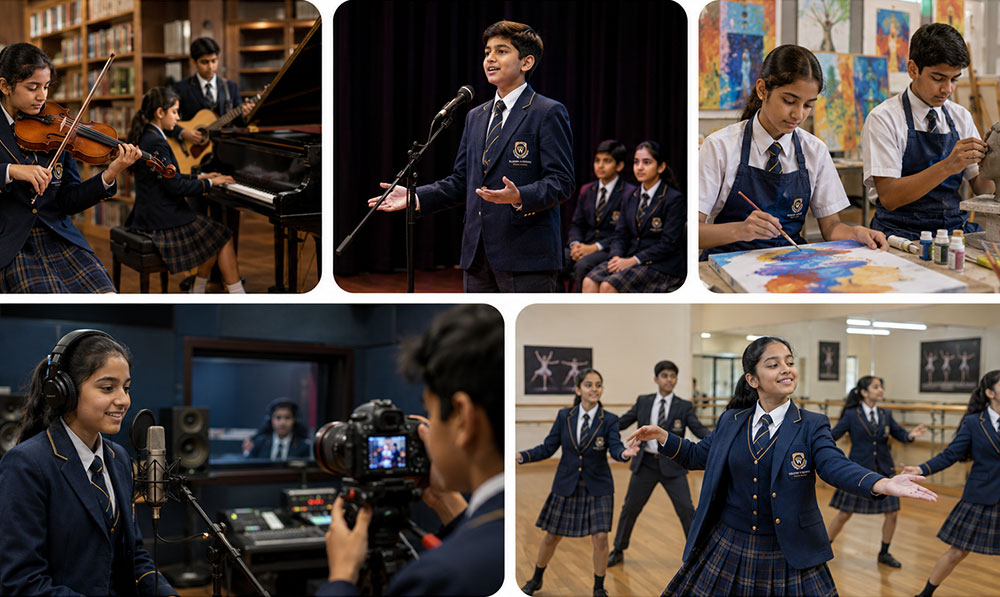
CLARWYN CONNECTION Communication across the Clarwyn experience At Clarwyn, communication is designed to grow across classrooms, the Atheneum Library, laboratories, projects, arts, music, recording, debates, presentations and performance spaces such as Forum 208 and The Great Hall. The Wisdom Compass connects Courage with Courtesy: students should be willing to speak, ask and perform while also listening, respecting the audience and improving their work with Craftsmanship. |
Communication confidence is built through hundreds of small experiences. When children are heard, challenged with care and invited to try again, expression becomes clearer and courage becomes more durable.