
Key Highlights
- Understanding why purposeful play matters in the early years
- Supporting language, motor, social and cognitive development
- The role of guided exploration and child agency
- How active learning can build independence and confidence
- The Clarwyn Praxis in foundation-stage education
- Learning through sensory activities, stories, movement and role play
- Creating a smooth transition towards formal learning
Introduction
The early years of education are not simply preparation for formal schooling. They are a period when children develop foundational habits of communication, movement, social interaction, curiosity and independent thinking. For this reason, the quality of a child’s early learning environment can influence how confidently they approach future learning.
At Clarwyn International School, Noida, the purposeful play and active learning can make these early experiences more meaningful. For parents considering Top CBSE Schools in Noida, a developmentally appropriate learning environment can offer children opportunities to explore through movement, stories, role play, sensory activities, art, conversation and guided tasks.
Why Purposeful Play Matters in Early Childhood
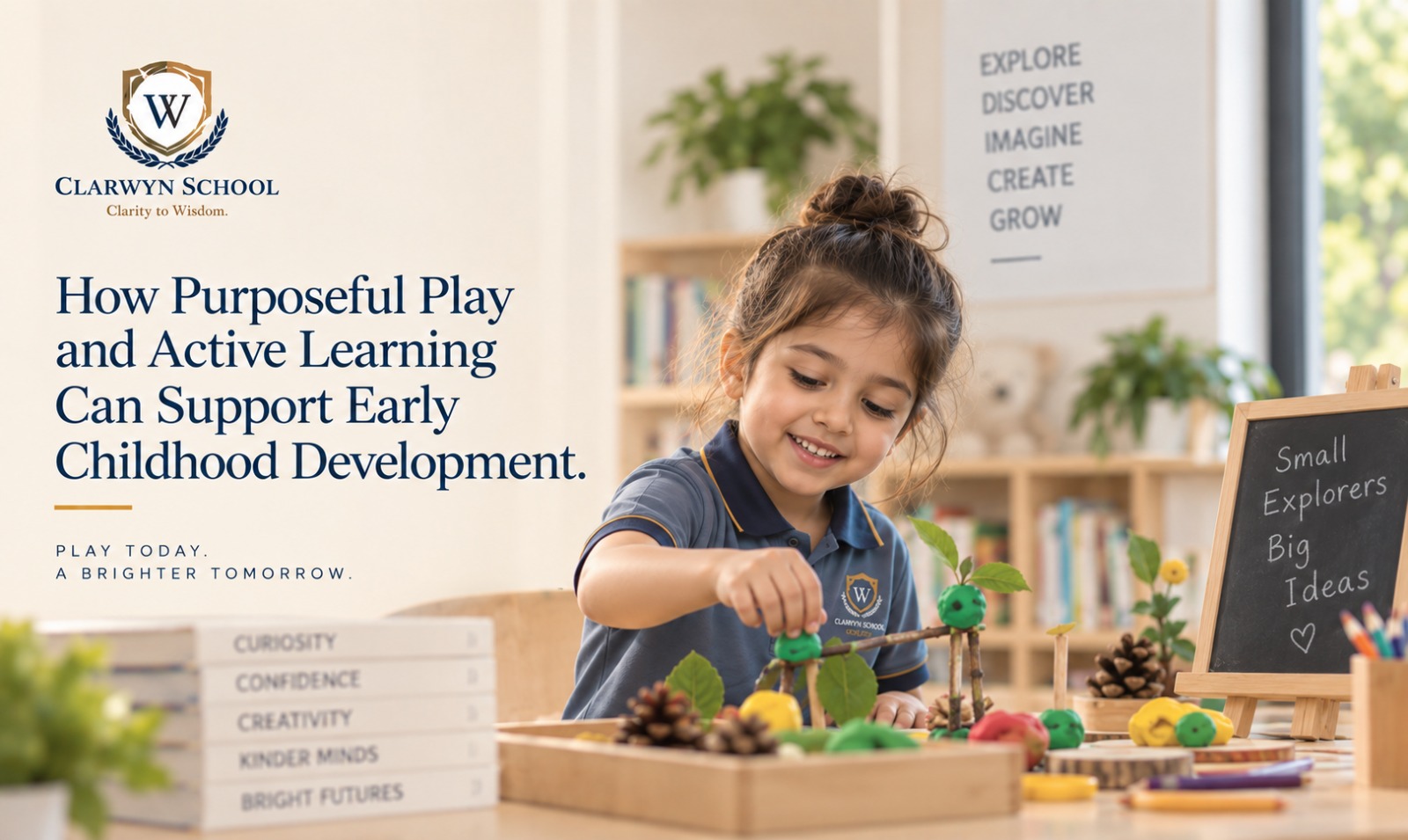
Play is one of the most natural ways young children make sense of their surroundings. Through building, pretending, moving, talking and experimenting, children can test ideas and learn how different actions produce different outcomes.
However, purposeful play is different from simply giving children free time. It involves thoughtfully designed activities, suitable environments and responsive adult guidance. Teachers can introduce a concept, observe children’s responses, ask questions and provide support when needed.
The foundation-stage approach here describes early learning as play-rich, language-rich, teacher-guided, child-active and space-supported. Activities include stories, conversation, music, movement, role play, sensory exploration, art, early numeracy and picture reading.
This creates opportunities for children to learn while remaining actively involved in the process.
How Active Learning Supports Holistic Development
Active learning allows children to participate rather than simply listen. When a child builds a structure with blocks, for example, they may simultaneously practise coordination, spatial awareness, problem-solving and communication.
Different experiences can support different areas of development:
This kind of learning also allows children to revisit skills repeatedly in different contexts, helping them gradually become more comfortable with new ideas.
From Play to Language and Communication
Language development is especially important during the early years. Conversations, stories, songs and role play provide children with opportunities to hear new vocabulary and express their own thoughts.
A child pretending to run a shop, for example, may practise asking questions, naming objects, counting items and interacting with another child. A story session can encourage children to predict what happens next, describe characters and retell events.
The foundation model includes stories, conversation, music, movement and role play, making language a natural part of everyday learning rather than something restricted to a separate lesson.
Building Independence Through Guided Exploration
Early childhood education should gradually help children become more independent. Simple routines such as organising materials, choosing an activity, completing a task and communicating their needs can contribute to this development.
The school’s published approach draws inspiration from several early-learning philosophies, including Montessori-inspired prepared environments, Reggio Emilia-inspired expression and documentation, Froebelian play, HighScope active learning, guided play with scaffolding and project inquiry.
These influences share an important principle: children should be active participants in learning while adults provide appropriate structure and support.
The HighScope-inspired Plan–Do–Review idea, for instance, connects choice with action and reflection, helping young learners gradually understand that their decisions and efforts have consequences.
The Role of Purpose-Built Learning Spaces
For young children, the physical environment can become part of the learning experience. Spaces should encourage safe movement, exploration, conversation and imaginative play.
The early-years ecosystem includes thematic classrooms, School Play Town, Indoor Soft Play, Splash Pool, Sand Pit, Outdoor Play Park and play equipment, along with daycare and crèche facilities.
The important consideration for parents is not simply how many facilities a school has, but whether children are actually using these spaces to explore, communicate, move and develop independence.
The Clarwyn Praxis and Early Learning
The Clarwyn Praxis follows five stages: Understand, Question, Practise, Apply and Reflect. While the level of complexity changes with age, the underlying principle remains consistent—children should be active participants in learning.
In early childhood, this may look like a teacher introducing a story, encouraging children to ask questions, allowing them to explore through play, supporting practice and then helping them talk about what they experienced.
The process can gradually develop the habit of thinking about learning rather than simply completing activities.
What Parents Should Look For
When visiting a school, parents can observe whether:
- Teachers interact warmly and patiently with children.
- Children have opportunities to choose and explore.
- Activities involve movement, conversation and creativity.
- Indoor and outdoor spaces are used meaningfully.
- Routines encourage age-appropriate independence.
- Teachers guide rather than unnecessarily control play.
Conclusion
Purposeful play and active learning can give children a strong foundation by making learning engaging, social and developmentally appropriate. At Clarwyn International School, Noida, through stories, movement, sensory exploration, role play, creative activities and guided inquiry, children can gradually develop communication, coordination, curiosity, confidence and independence.
For families comparing Best CBSE Schools in Noida, the early-years approach deserves as much attention as the senior academic programme. A thoughtfully designed foundation stage can help children develop positive learning habits before formal academics become more demanding.
FAQs
Q. 1 What is purposeful play in early childhood?
Ans : Purposeful play involves thoughtfully planned activities where children explore, communicate and develop skills with appropriate teacher guidance.
Q. 2 How does active learning benefit young children?
Ans : It encourages children to participate directly in learning while supporting communication, motor development, problem-solving, creativity and social skills.
Q. 3 What activities support early childhood development?
Ans : Stories, role play, music, movement, sensory exploration, art, early numeracy and outdoor play can support different areas of development.
Q. 4 What is The Clarwyn Praxis?
Ans : It is a learning rhythm based on Understand, Question, Practise, Apply and Reflect, designed to keep learning active and purposeful.
Q. 5 How does the early-years environment encourage independence?
Ans : Prepared spaces, predictable routines, guided choices, purposeful play and age-appropriate responsibilities can help children gradually develop independence.
Q. 6 Why should parents observe the learning environment before admission?
Ans : A school visit allows parents to see how teachers interact with children, how spaces are used and whether the environment feels safe, engaging and developmentally appropriate.