
Beyond Impressive Facilities: How to Know Whether a School Campus Supports Learning
A beautiful room matters only when children know what to do there, trained adults guide the work and the experience produces learning that can be explained.
School campuses are often introduced through numbers: how many laboratories, how many sports, how large the library, how many seats in the auditorium. These details are useful, but they do not tell parents whether a child will experience meaningful learning there.
A facility becomes educational only when it is connected to purpose, access, adults, tools, student work, evidence, safety and stewardship.
1. Purpose: What is this space for?
The answer should be more specific than ‘experiential learning’. A science laboratory may support observation, measurement, safe technique and evidence-based explanation. A library may develop reading, research, source use and quiet study. A theatre may support rehearsal, presentation, critique and audience responsibility.
When the purpose is clear, the school can decide what belongs in the room and what students should learn there.
2. Access: Who uses it, and how often?
A premium space that is rarely timetabled adds little to the daily learner experience. Ask which grades use the space, whether access is protected in the timetable and how group size is managed.
Access should progress with age. Younger children may observe, sort, build and explore safely; older students may use specialised methods, equipment and increasingly independent application.
“A campus earns its educational value when space, people and purpose meet in the work students can explain.”
3. Adults: Who leads the learning?
Equipment does not teach by itself. Specialist spaces need adults who understand the subject, the age group, the tools and the relevant safety routines.
Parents can ask how teachers are prepared to use the space, how technicians or coaches support them and what happens when equipment is unavailable or under maintenance.
4. Tools: Are materials chosen for learning or display?
The most expensive device is not always the most useful one. A strong resource set allows repeated practice, variation, collaboration and progression. Consumables, storage, reset routines and maintenance are as important as the headline equipment.
A school should be able to explain why a tool is present and which learning sequence it supports.
|
Eight questions to ask about any school facility 1. What is the learning purpose of this space? 2. Which grades use it, and how frequently? 3. Who is trained to lead the work? 4. What skills or concepts progress over time? 5. What will students make, test, perform or explain? 6. How will feedback and improvement be captured? 7. What safety, maintenance and supervision routines apply? 8. How will every learner receive fair access? |
5. Outputs: What will students produce or perform?
A meaningful visit to a specialist space should leave evidence: data, a model, a tested design, an improved performance, a research note, a recorded explanation, a reflection or another piece of work worth sharing.
The output need not always be polished. Drafts, errors, feedback and revision often reveal more about learning than a perfect display.
6. Safety and stewardship: How is responsible use taught?
Safety is not a sentence in a brochure. It includes appropriate design, trained adults, equipment checks, supervision, clear routines, emergency response and regular review.
Stewardship also matters. Students should learn to care for tools, return materials, use shared spaces respectfully and understand that access comes with responsibility.
7. Evidence: How will families know the space is making a difference?
Photographs can show participation; they cannot by themselves show learning. Stronger evidence includes student explanation, work samples, before-and-after improvement, performance criteria, laboratory records, portfolios and thoughtful teacher commentary.
Ask what families will see over time, not only what visitors can see on the tour.
|
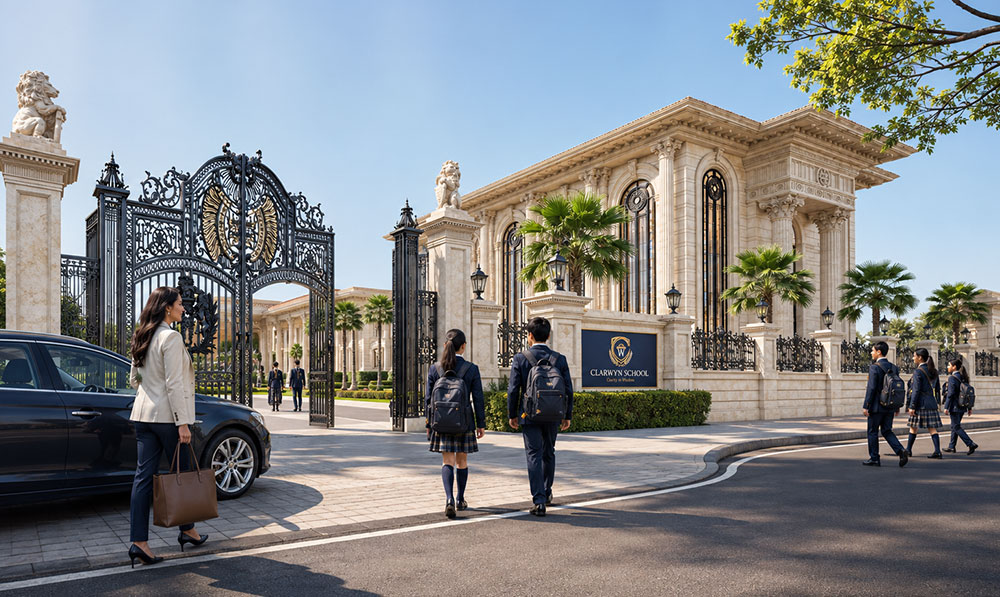
CLARWYN CONNECTION A campus planned as a learning system Clarwyn’s 2.2+ lakh sq. ft. covered learning area is planned around this principle. The campus brings together 25+ laboratories, studios and activity spaces; 30+ sports and games; the Atheneum Library; Aqua 26; Forum 208; The Great Hall; and purpose-built Foundation Years spaces. The intention is not simply to offer breadth. Every major space is being connected to a learning purpose, age-appropriate access, adult responsibility, expected student output, evidence, safety and stewardship. Campus tours are designed to explain those connections rather than only display the architecture. |
Facilities should expand what children can understand, practise, create and contribute. When parents evaluate a campus through use rather than appearance, the school choice becomes much more informed.