
Key Highlights
- Why curiosity is important for meaningful learning
- What purposeful learning looks like in everyday classrooms
- The role of questioning, practice, application and reflection
- How parents can evaluate learning spaces and teaching methods
- The importance of values, independence and real-world skills
- Understanding the role of The Clarwyn Praxis and Wisdom Compass
Introduction
Choosing a school involves looking beyond classrooms, infrastructure and examination results. Parents increasingly want to understand how their child will actually learn each day. Will students be encouraged to ask questions? Will they have opportunities to experiment, research and create? Can they connect classroom concepts with practical experiences?
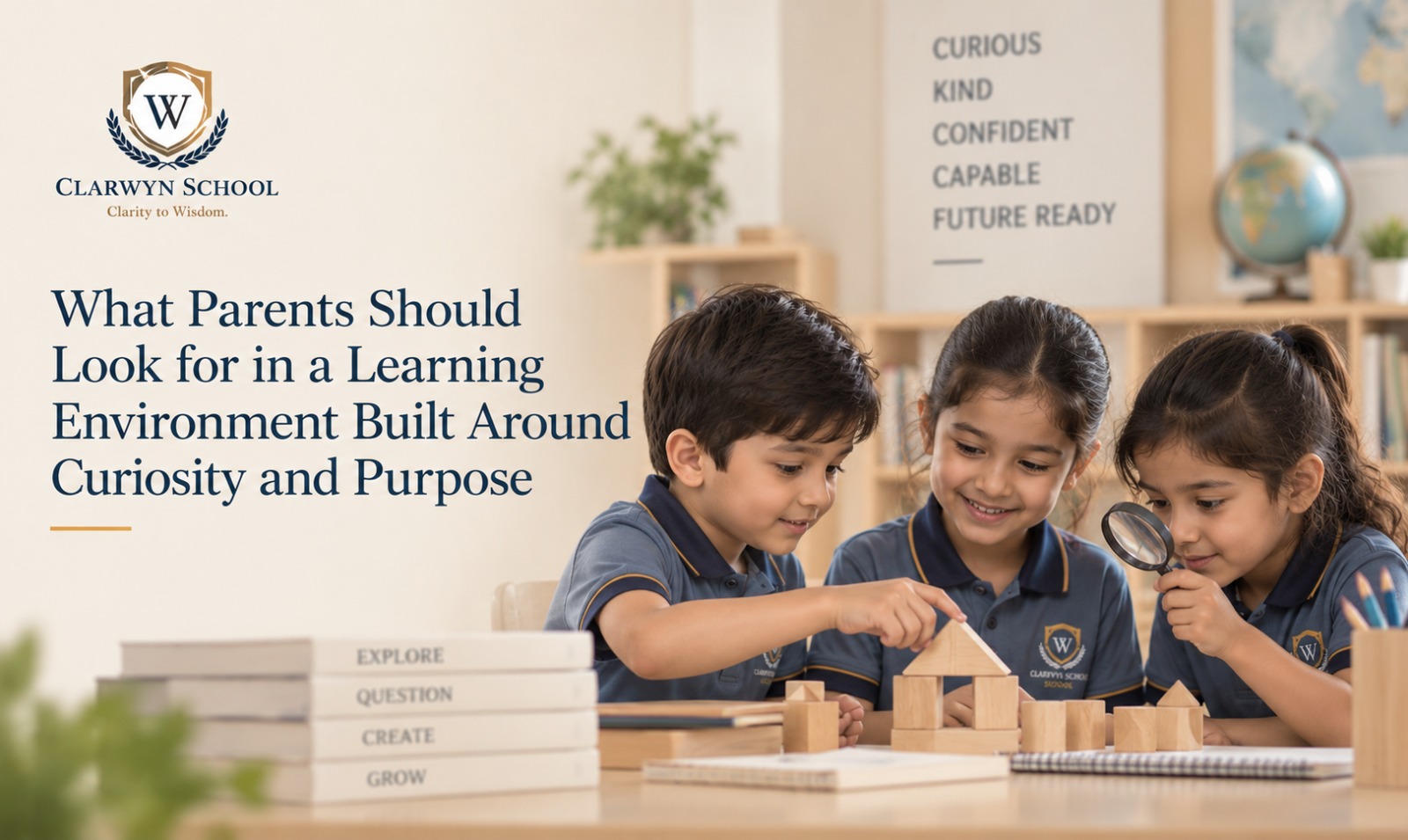
At Clarwyn International School, Noida, a learning environment built around curiosity and purpose gives children opportunities to explore ideas while maintaining a clear academic direction. For parents exploring the Best CBSE School in Noida, this approach highlights how education can go beyond textbook learning. Instead of treating learning as the memorisation of information, such an environment encourages students to understand concepts, ask meaningful questions, practise skills, apply knowledge and reflect on their progress.
Why Curiosity Matters in a Child’s Learning Journey
Curiosity encourages children to look beyond the first answer. When students are allowed to ask why, how and what if, they begin to develop habits of investigation and independent thinking.
However, curiosity becomes most valuable when it has direction. A purposeful learning environment does not simply allow students to explore anything without guidance. Teachers provide learning goals, model processes, ask relevant questions and help children turn curiosity into meaningful work.
What Makes a Learning Environment Purposeful?
Purposeful learning means that students understand what they are learning and why it matters. A mathematics lesson, for example, could move from understanding a concept to using it to interpret data. A science topic could progress from classroom explanation to experimentation. A language activity could develop into research, presentation or discussion.
Parents can therefore look for evidence that students are doing more than completing worksheets. Are they researching? Are they building models? Are they presenting their ideas? Are they revising their work after receiving feedback?
Look for a Clear Learning Process
A strong learning environment should combine freedom to explore with sufficient structure. This balance is reflected in The Clarwyn Praxis, which follows five stages:
Understand → Question → Practise → Apply → Reflect
Students first understand the learning objective and expected standard. They then explore purposeful questions, practise with teacher guidance, apply their knowledge in real tasks and finally reflect on their progress.
For parents, this provides a useful framework when evaluating a school. Rather than asking only, “What will my child study?”, families can also ask:
- How are concepts introduced?
- How are students encouraged to question?
- What kind of practical work do they undertake?
- How is feedback provided?
- How do students demonstrate what they have learned?
These questions can reveal much more about everyday teaching than a list of subjects alone.
Learning Spaces Should Encourage Exploration
Infrastructure becomes meaningful when children actually use it for learning. A well-designed environment should give students opportunities to read, investigate, experiment, create, communicate and participate.
The campus model includes an Atheneum Library, science and subject laboratories, AI and robotics, engineering, technology, STEM, coding, venture, multimedia and arts spaces, alongside sports and early-years facilities.
Parents should therefore look beyond the number of facilities and ask a more important question: What will my child actually do in these spaces?
Values and Habits Matter Alongside Academics
Curiosity becomes more powerful when supported by positive learning habits. Children need courage to attempt challenging tasks, integrity to use information responsibly and perseverance to improve their work.
The Wisdom Compass is designed around eight habits: Clarity, Curiosity, Courage, Courtesy, Integrity, Craftsmanship, Mastery and Stewardship. These values connect academic development with behaviour, responsibility and personal growth.
For instance, craftsmanship encourages students to revise and pay attention to detail, while mastery emphasises practice, feedback and steady improvement. Stewardship extends responsibility towards people, spaces, resources and the wider environment.
What Parents Can Observe During a School Visit
A campus visit should be an opportunity to observe learning rather than simply inspect facilities. Parents can look for:
The school itself encourages families to use a campus visit to understand academics, foundation learning, facilities, values, care systems and the admissions journey together.
Conclusion
A meaningful learning environment should do more than provide children with information. It should help them understand, question, practise, apply and reflect. For parents exploring the Top CBSE Schools in Noida, these elements can offer a practical framework for evaluating whether a school genuinely supports curiosity while maintaining academic purpose.
At Clarwyn International School, Noida, the combination of structured teaching, applied inquiry, purposeful learning spaces and values-based development can help children gradually move from asking questions to researching answers, creating solutions and explaining their understanding.
FAQs Question
Q. 1 Why should parents look for curiosity-driven learning?
Ans : Curiosity encourages children to ask questions, investigate ideas and develop independent thinking rather than relying only on memorisation.
Q. 2 What is The Clarwyn Praxis?
Ans : It is a five-stage teaching-learning rhythm: Understand, Question, Practise, Apply and Reflect, designed to keep learning structured and active.
Q. 3 How does Applied Inquiry support CBSE learning?
Ans : It adds questioning, practical application, research and reflection to the structured academic progression offered through CBSE.
Q. 4 What should parents check during a campus visit?
Ans : Parents can observe classrooms, learning spaces, student work, teaching practices, safety systems, communication processes and opportunities for sports and creative activities.
Q. 5 What is the Wisdom Compass?
Ans : It represents eight learning and life habits: Clarity, Curiosity, Courage, Courtesy, Integrity, Craftsmanship, Mastery and Stewardship.
Q. 6 Does purposeful learning focus only on academics?
Ans : No. The approach extends into sports, arts, expeditions, community service and leadership, helping students develop confidence, responsibility and collaboration alongside academic skills.