
Key Highlights
- Understanding the role of purposeful play in early childhood
- How play can support language, movement, creativity and social development
- The importance of teacher-guided exploration
- Learning through stories, role play, sensory activities and movement
- How the environment can encourage curiosity and independence
- The role of The Clarwyn Praxis in foundation-stage learning
- Connecting early experiences with a child’s long-term learning journey
Introduction
The early years are a period when children are constantly discovering how the world works. At Clarwyn International School, Noida, a conversation, a story, a building activity or a simple game can become an opportunity to develop language, coordination, confidence and problem-solving abilities. This is why play has an important place in early childhood education.
However, meaningful play is not simply about keeping children occupied. Purposeful play involves carefully planned experiences that allow children to explore, make choices, communicate and develop skills with appropriate adult guidance. For parents evaluating the Top Schools in Noida, this approach highlights how thoughtfully designed play can create a bridge between a child’s natural curiosity and intentional learning.
What Makes Play Purposeful?
Purposeful play begins with a clear understanding of what children can learn through an activity. A pretend shop, for example, can involve much more than imagination. Children may practise speaking, counting, taking turns, recognising objects and making decisions.
Similarly, building with blocks can encourage spatial awareness and coordination, while a story can develop listening, vocabulary and the ability to sequence events.
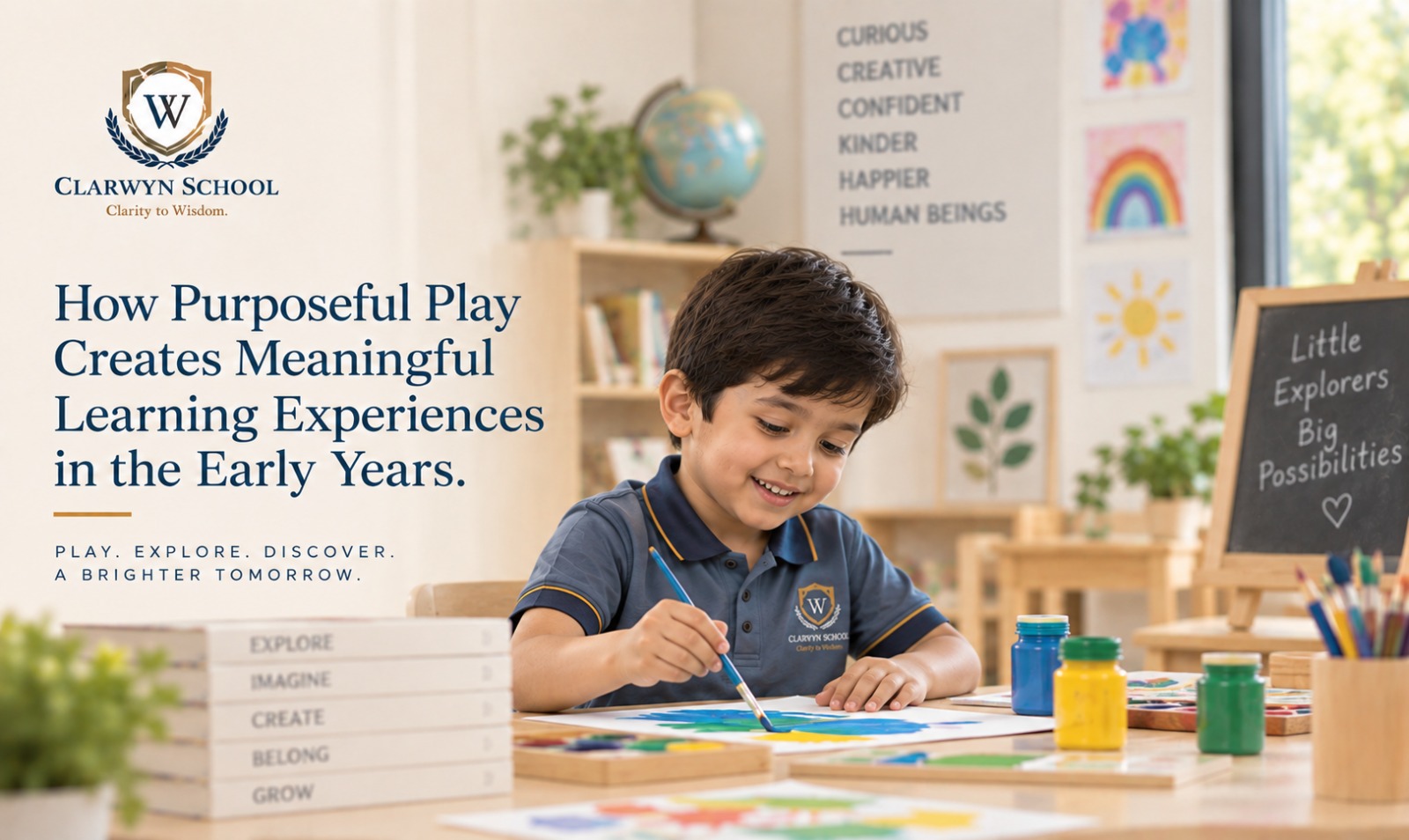
The foundation-stage model here describes learning as play-rich, language-rich, teacher-guided, child-active and space-supported. Activities include stories, conversation, music, movement, role play, sensory exploration, art, early numeracy and picture reading.
The objective is to make learning active without placing unnecessary academic pressure on young children.
How Play Supports Holistic Development
Children develop several skills simultaneously during play. When they interact with materials, peers and adults, cognitive, physical, emotional and social development can happen together.
This integrated approach is valuable because young children do not always separate learning into individual subjects. A single activity can naturally involve language, mathematics, creativity and social interaction.
Turning Everyday Activities into Learning Opportunities
One of the strengths of purposeful play is that it can connect learning with familiar experiences. Children can count objects while organising toys, describe colours while creating artwork or use new vocabulary while participating in role play.
The learning environment described by the school includes spaces such as School Play Town, Indoor Soft Play, Splash Pool, Sand Pit, Outdoor Play Park and thematic classrooms, providing different settings for children to explore through movement and imagination.
The Role of Teachers in Purposeful Play
Teachers play an important role in ensuring that play remains meaningful. They can observe children’s interests, introduce questions, model language, provide suitable materials and offer support when a child encounters difficulty.
The published early-learning approach draws on several educational influences, including Montessori-inspired prepared environments, Reggio Emilia-inspired expression and documentation, Froebelian play, HighScope active learning, guided play with scaffolding and project inquiry.
The HighScope-inspired Plan–Do–Review principle is particularly relevant to purposeful learning because it connects children’s choices with action and reflection.
Creating an Environment for Active Learning
A meaningful early-years environment should encourage children to move, communicate, investigate and interact. The physical setting can become an extension of the learning experience when spaces are designed for age-appropriate exploration.
The early-years ecosystem includes thematic classrooms, play areas, sensory opportunities and outdoor facilities. The school’s Learning Evidence Map describes the early-years progression as “Play, Speak, Move, Share, Belong,” with observable outcomes such as speech confidence, motor coordination, social routines, attention and curiosity.
This is an important distinction for parents. Facilities are most valuable when they support specific developmental experiences rather than existing simply as infrastructure.
What Parents Should Look For
When evaluating an early-years programme, parents can look beyond brochures and observe the actual learning environment. Consider asking:
- Are children encouraged to ask questions?
- Do teachers interact patiently and meaningfully with children?
- Is play connected to learning objectives?
- Are children given opportunities to make age-appropriate choices?
- Are indoor and outdoor spaces used actively?
- Do activities encourage language and social interaction?
- Are routines helping children develop independence?
- Are safety, health and parent communication systems clearly explained?
A campus visit can be especially useful because it allows families to observe how children interact with teachers, spaces and learning materials. The published admissions journey specifically encourages families to visit and understand the early-years zones, academics, campus, care systems and wider school experience.
Conclusion
Purposeful play can transform the early years from a period of simple activity into a meaningful foundation for lifelong learning. At Clarwyn International School, Noida, through stories, movement, role play, sensory exploration, art and guided discovery, children can develop communication, coordination, curiosity, confidence and social skills in ways that feel natural to them.
For parents exploring the Top 10 Schools in Noida, the quality of early-years education deserves careful attention. A school should offer more than attractive classrooms or activity schedules; it should provide an environment where children are encouraged to explore, communicate, make choices and learn from their experiences.
FAQs Question
Q. 1 What is purposeful play?
Ans : Purposeful play involves thoughtfully designed activities through which children explore, communicate and develop skills while receiving appropriate teacher guidance.
Q. 2 How does purposeful play support early childhood development?
Ans : It can support language, motor coordination, creativity, social interaction, curiosity, confidence and early problem-solving skills.
Q. 3 What activities can encourage meaningful play?
Ans : Stories, role play, music, movement, sensory exploration, art, construction activities, early numeracy and outdoor play can all create meaningful learning opportunities.
Q. 4 What is The Clarwyn Praxis?
Ans : It is a five-stage teaching-learning rhythm based on Understand, Question, Practise, Apply and Reflect.
Q. 5 Why is teacher guidance important during play?
Ans : Teachers can observe children’s interests, ask purposeful questions, introduce new ideas and provide support while still allowing children to explore independently.
Q. 6 What should parents observe during an early-years school visit?
Ans : Parents can observe teacher-child interaction, children’s engagement, learning spaces, play opportunities, routines, safety measures and how the school communicates with families.