
Curriculum

Clarity
Mastery
Craftsmanship
How to read our curriculum
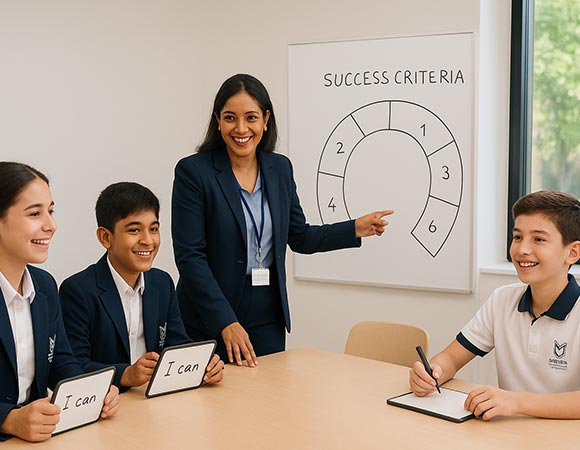
We organise learning by stage and by discipline. Every unit follows the school’s six-step lesson arc, so knowledge sticks and shows up in real-world spaces like labs, studios, and the Library.
Early Years (Pre‑Primary) — play to practice
Children explore language and early numeracy through guided play and calm routines. Role-play, sensorial trays, songs, and movement help build social habits such as sharing, waiting, and caring for materials.
Where it happens: language & numeracy corners, sensorial shelves, a Wonderland role‑play area, an indoor junior zone, and outdoor spaces that encourage safe movement and curiosity.
What comes home: picture‑word banks, simple reading routines, and short talk prompts so families can join in.
Primary (I–V) — concept‑first & literacies
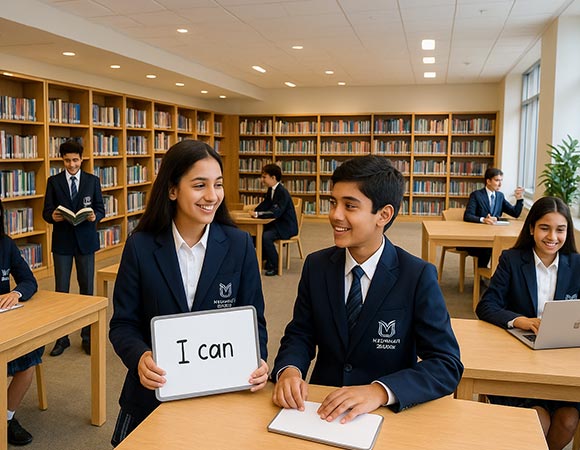
Students build strong reading and writing habits, practise maths in workshops, and learn to investigate the world through mini‑labs and short field tasks. Clear criteria and examples make quality visible.
Typical outcomes: short reports, ratio posters, and oral‑history maps. Families can view exemplars, ensuring support at home remains aligned.
Middle (VI–VIII) — specialism with confidence
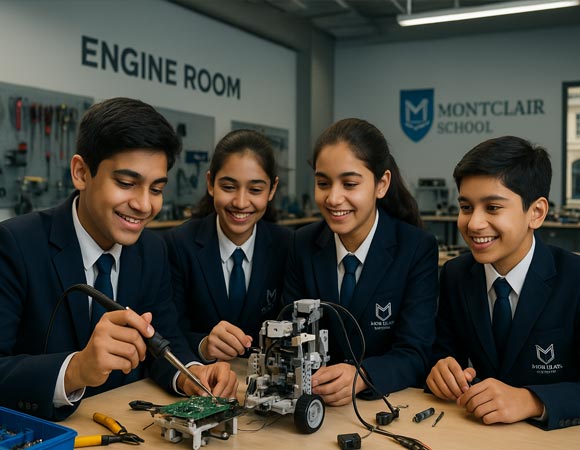
Subject specialists lead deeper study in science labs and project studios. Students learn study skills, note systems, and how to defend a conclusion with data or sources.
Typical outcomes: data sheets and graphs, CER write‑ups, debates, and prototypes tested in our labs and studios.
Secondary & Senior — depth, writing, futures
Students use diagnostics and targeted practice to close gaps, write from exemplars, and complete research or design capstones. Guidance supports internships and university planning without hype.
Typical outcomes: extended essays, viva‑style defences, capstone presentations, prototypes with pitches, and showreels.
Discipline strands — what that means for your child
Languages & Library
Reading ladders, guided groups, and literature circles build stamina and taste. Library clinics teach how to narrow a question, paraphrase ethically, and cite correctly.
Mathematics & Science
From manipulatives to models: students move from concrete to abstract and practise fair tests in science. Composite Science (VI–X) builds apparatus confidence before senior specialisation.
Technology & Computing (CodeForge)
Students keep organised files and produce clean documents, charts, and slides. Age‑graded coding pathways lead into sensors and control, always with digital citizenship in view.
Innovation & Entrepreneurship (Venture Studio)
Problem → prototype → pitch. Teams interview users, test ideas, and explain value in two minutes with a working demo.
Creative Media (Pixel Forge)
Students learn about framing, light, sound, and editing to tell honest stories with the consent of those involved. Public screenings build confidence and audience etiquette.
Social Sciences & Civics
Students learn to effectively use sources and maps, build timelines, and conduct civic simulations that make public life more legible.
PE & Sports
Skill ladders and fitness build confidence and teamwork; wellness routines support healthy habits.
FAQs
By stage (Early Years, Primary, Middle, Secondary & Senior) and by discipline strands—Languages & Library; Mathematics & Science; Technology & Computing; Innovation & Entrepreneurship; Creative Media; Social Sciences & Civics; Physical Education & Sports.
Primary: short reports, recipe‑ratio posters, and local‑history maps. Middle: data sheets with graphs, CER write‑ups in science, debates, and prototypes—often in the Library, labs, CodeForge/AI & Robotics, and Pixel Forge.
The Atria Library runs Research Bootcamps (IX–XI) and clinics on questions, source triage, note‑taking, paraphrase vs patch‑write, and citation integrity.
Science Labs focus on natural‑science investigations and measurement; Technology/AI & Robotics focus on computing, sensors, and control; the STEM Activity Bay integrates disciplines with hands‑on kits for approachable builds.
Daily retrieval checks and exit tickets guide same‑day reteach or enrichment; term benchmarks use exemplars and reports emphasise next steps over raw scores.
Read and talk together regularly, encourage short retrieval practice, and ask your child to ‘show the steps’ or ‘explain the graph’ rather than only the answer.